
Hello, I am Dr. Hidenori Shimada of Grand Green Osaka Umekita Clinic in Osaka, Japan.
If you already see a doctor for joint pain or another long-term condition, you may wonder how adipose-derived stem cell therapy in Japan would fit alongside the care you receive now. This is one of the most practical questions international patients ask, and it is worth thinking through before you travel. This article explains the kinds of points to raise at a consultation, so that you arrive prepared rather than uncertain.
The short answer: it depends on your doctor’s assessment
Adipose-derived stem cell therapy is a regenerative medicine option in which mesenchymal stem cells taken from your own fat tissue are cultured, expanded, and returned to your body by intravenous infusion. It is offered in Japan as a private, self-pay treatment, which means it is not covered by public health insurance. It is not presented as a replacement for standard medical care, and it is not a guaranteed way to change the course of any condition.
Whether it could be considered alongside your current treatment depends on your medical history, your diagnosis, the medicines you take, and your overall health. Only a physician who has examined you and reviewed your records can judge this. Any information on a website, including this article, is general background and not a personal recommendation.
Why continuing your existing care matters
Standard treatments such as medication, physiotherapy, exercise programs, weight management, and the follow-up arranged by your home doctor are built on established clinical experience and guidelines. For conditions such as knee osteoarthritis, these approaches remain the foundation of care in most countries. Research on mesenchymal stem cells is active worldwide, but results across studies vary, and findings from one study should not be generalized to every patient.
For this reason, a responsible consultation does not ask you to stop treatment that is working for you. Instead, it asks what you are doing now, how well it is helping, and what you hope to understand or explore. If you decide to proceed, your home doctor should ideally remain informed so that your care stays coordinated.
Information to bring to your first consultation
Preparing a clear summary makes the conversation with the physician at Grand Green Osaka Umekita Clinic more productive. Consider gathering the following, ideally with an English translation or a Japanese summary where possible:
- Your diagnosis and the date it was made, with any imaging reports such as X-ray or MRI findings.
- A current medication and supplement list, including blood thinners, anti-inflammatory drugs, and steroids.
- Records of past surgeries, injections, or procedures, and any reactions you experienced.
- Known allergies, especially to local anesthetics, antibiotics, or other medicines.
- Recent blood test results and any chronic conditions such as diabetes, heart disease, or autoimmune disease.
- Your own goals, written plainly, such as the activities you would like to be able to do more comfortably.
Some medicines and health conditions may affect whether the procedure can be considered or how it is planned. Fat collection is performed under local anesthesia, so the doctor will also want to know about your history with anesthetic agents. These details are checked individually and cannot be decided in advance.
Questions worth asking about the process and follow-up
A good consultation leaves room for questions. Because this treatment involves collecting a small amount of fat, culturing cells at a specialized facility, and then infusing them, you may want to understand each step and what follows. Useful questions include:
- How is my current medication handled before and after fat collection and infusion?
- What are the possible risks and side effects for someone with my history, and how are they monitored?
- How much time should I plan to spend in Osaka, and are there steps that require a return visit?
- What follow-up is available after I go home, and how can I contact the clinic if I have concerns?
- What is included in the fee, and what costs are separate?
- How should I share information with my doctor at home?
Asking these questions in advance helps you compare options calmly. If an answer is unclear, it is reasonable to ask for it in writing before making any decision.
Understanding the regulatory framework in Japan
In Japan, treatments of this kind are provided under the Act on the Safety of Regenerative Medicine and related rules. Under this system, a clinic submits a treatment plan for review, and cell culture is carried out at facilities designated for that purpose. The framework sets requirements for how treatment is planned, explained to patients, and reported. It does not mean that a treatment is approved as a standard therapy or that a particular result can be expected.
Because this is a self-pay service, costs, risks, side effects, and suitability should all be confirmed directly with the physician. Take your time reading the explanation and consent documents, and ask for clarification where needed.
Planning your visit as an international patient
Grand Green Osaka Umekita Clinic is located in the Umeda area of Osaka, which is well connected by rail and convenient for visitors. The clinic provides an information page for international patients, which can help you understand how to make an inquiry and what to prepare before arriving. If language is a concern, mention it when you contact the clinic so that your consultation can be arranged accordingly.
Before booking travel, review the treatment page and the sections on flow, fees, and frequently asked questions. These explain the general steps and offer a starting point for your own list of questions. Then consider speaking with your home doctor about your plans.
Summary
Adipose-derived stem cell therapy is a self-pay regenerative option that should be discussed with a physician, not assumed to suit everyone. It is not a substitute for standard care, and outcomes cannot be promised. Bringing your medical records, medication list, and clear questions to a consultation in Osaka lets the doctor assess your situation and explain the risks, side effects, and costs honestly. A calm, well-prepared conversation is the best first step toward an informed choice.
- 1Gather recordsDiagnosis and imaging reports
- 2List medicinesIncluding supplements
- 3Write questionsRisks, fees, follow-up
- 4Doctor assessmentSuitability is judged individually
This figure is a conceptual diagram that summarizes the article
References
- PubMed: Clinical Efficacy and Safety of the Intra-articular Injection of Autologous Adipose-Derived Mesenchymal Stem Cells for Knee Osteoarthritis: A Phase III, Randomized, Double-Blind, Placebo-Controlled Trial. (2023)
- PubMed: Injection of human umbilical cord mesenchymal stem cells exosomes for the treatment of knee osteoarthritis: from preclinical to clinical research. (2025)
- PubMed: Intra-Articular Injection of Autologous Adipose Tissue-Derived Mesenchymal Stem Cells for the Treatment of Knee Osteoarthritis: A Phase IIb, Randomized, Placebo-Controlled Clinical Trial. (2019)
- PubMed: Clinical-grade extracellular vesicles derived from umbilical cord mesenchymal stromal cells: preclinical development and first-in-human intra-articular validation as therapeutics for knee osteoarthritis. (2025)
- PubMed: Adipose-derived mesenchymal stem cell therapy in the treatment of knee osteoarthritis: a randomized controlled trial. (2019)
- PMC: What is the optimal dose of adipose-derived mesenchymal stem cells treatment for knee osteoarthritis? A conventional and network meta-analysis of randomized controlled trials. (2023)
- PMC: Rapid-acting pain relief in knee osteoarthritis: autologous-cultured adipose-derived mesenchymal stem cells outperform stromal vascular fraction: a systematic review and meta-analysis. (2024)
- PMC: Therapeutic efficacy of intra-articular injection of human adipose-derived mesenchymal stem cells in a sheep model of knee osteoarthritis. (2025)
- MHLW (Japan): Regenerative Medicine — Ministry of Health, Labour and Welfare, Japan
Supervising Physician
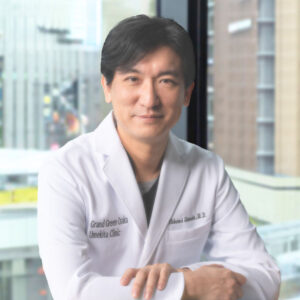
Director, Medical Corporation Shimada Clinic
Head of Clinical Practice, Grand Green Osaka Umekita Clinic
Hidenori Shimada
Graduated from the University of Tokushima Faculty of Medicine in 2005. After his initial residency, he obtained U.S. medical certification (ECFMG) and trained as a sub-intern in general surgery at the University of Washington. After completing the doctoral program at Kyoto University Graduate School of Medicine and working as a researcher at the Center for iPS Cell Research and Application (CiRA), Kyoto University, he founded Shimada Clinic in 2013. At Grand Green Osaka Umekita Clinic (https://umekitaclinic.org), he is engaged in a wide range of care, from internal medicine and pediatrics to cell therapy and aesthetic medicine.
* The physician supervision of this article covers its academic content only and does not constitute a recommendation of any specific treatment or product.